
Plucky Survivors See Europe Day 3: Berlin
Date: June 3, 2026
Start: Berlin, Germany
End: Berlin, Germany
Miles Traveled: 11,709 (ish) steps
Highlights:
- The Disgusting Food Museum
- Checkpoint Charlie
- Die Mauer – Divided Berlin Panorama
The rain ended earlier than expected so I headed out to see how much of my list of sights I could accomplish. The answer is, a lot!
Before I get to the day’s agenda, a quick note to the people who design hotel rooms. On behalf of just about everyone on earth, we want walls and a door between the place where people are sleeping and the place people are using the toilet.
There is a wall between those room in my Berlin hotel but instead of a headboard there’s a rose-tinted window looking at the tub. The shower has similar red glass, and you can see into it from just about anywhere in the room. It’s also like just about every other glass enclosed shower in that the door doesn’t completely seal and water goes all over the place while you’re lathering.
There’s an entire website devoted to tracking hotels with and without bathroom doors in their rooms – BringBackDoors.com. I wholeheartedly endorse this.
But I got over it because Berlin awaited.
Now considering myself a U-Bahn (subway) expert, I hopped the train for a quick jaunt to the Tiergarten Park area, also known as the Diplomatic Quarter where a lot of the embassies are located.
My first stop was the Memorial to Homosexuals Persecuted under Nazism. It’s in a wooded section of the park and a bit difficult to find unless you stumble upon it. I was looking for it and had almost given up when it was suddenly just there.
It’s a big concrete cube with a window on one end, through which you can view a video of two men kissing or two women doing the same. It’s a simple but powerful testament to the estimated 100,000 people who were killed under the regime.

Monument to murdered homosexuals during the Nazi regime.
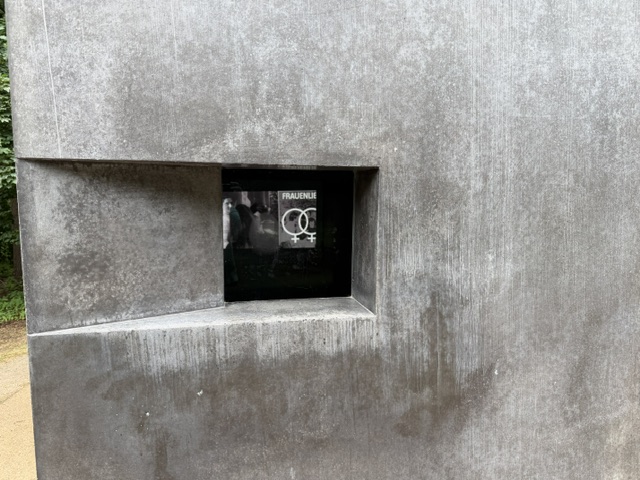
Looking through the window at the monument.
The park is filled with statuary, including this one dedicated to German poet Johann Wolfgang von Goethe and if ever there was a German name, that would be it.
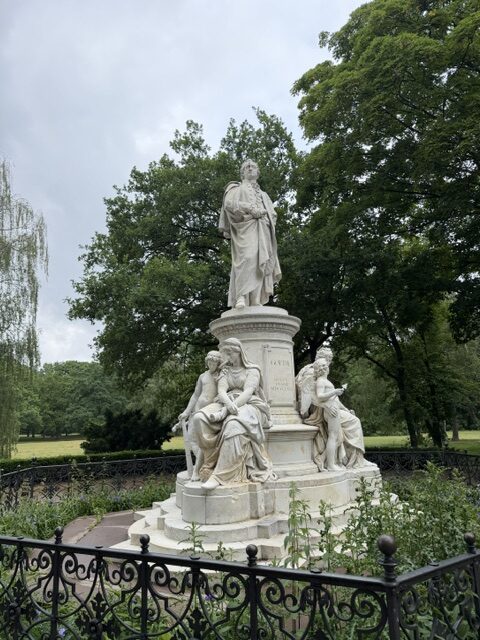
A poet and didn’t know it.
Another part of the park has a memorial to the Roma and Sinti people (aka gypsies) who were murdered by the Nazis. A wall of translucent glass panels with the story of the estimated 500,000 people who died encloses a simple, circular reflecting pool with a triangular stone set into representing the badges worn by concentration camp prisoners.
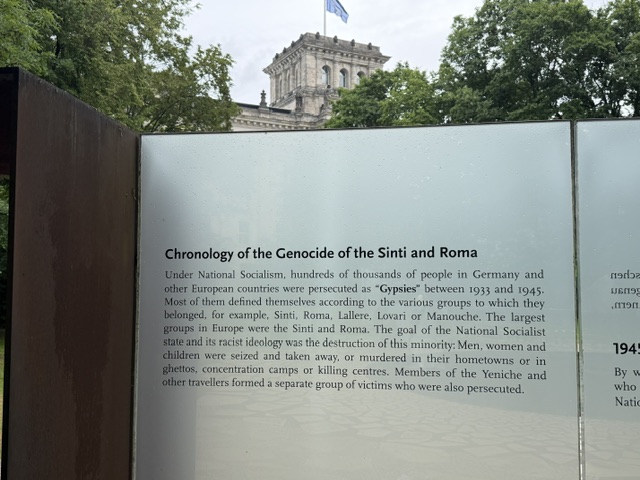
You have the Cher song stuck in your head now, don’t you?

The triangle symbolizes the badges prisoners wore.

Personal stories of the Roma-Sinti people.
Berlin 101 was accomplished next by snapping some pics of the Reichstag Building, the home of the German government. It was the scene of an arson fire in 1933 just a few weeks after Hitler was sworn in as chancellor. He and his government blamed communists and used the incident to suspend most civil liberties of the German people, a move that presaged most of what was going to happen over the next 12 years or so.
I didn’t go inside for a tour, most of which sounded long and boring, so instead I headed to the next Berlin 101 destination, the Brandenburg Gate, but first snapping a picture of the TV Tower down the road.
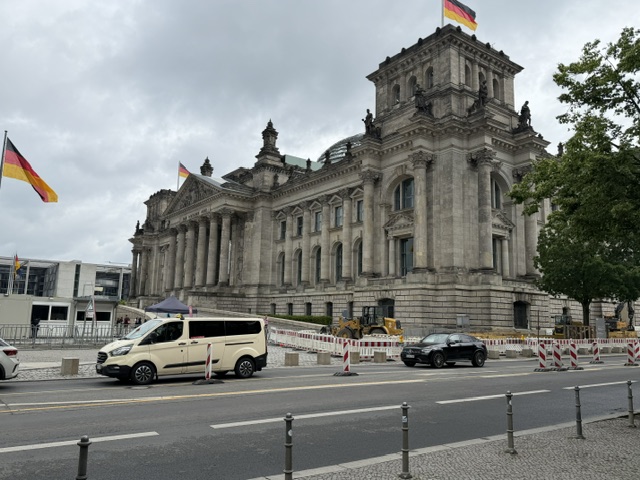
The Reichstag building.

TV Tower in the distance. No, I won’t be going up there.
The gate was built in the late 1700’s, it marked the beginning of the road from Berlin to Brandenburg, which had been the capital of Germany. The gate was blocked by years by the Berlin Wall, but restored when the city was reunited in 1990.
Another public service announcement, this time directed at tourists. Sure, I’ll take your photo in front of whatever thing you want to prove you visited, but if you start giving me art direction, telling me which way to hold the camera, asking me to bend down to get the best angle, or pretty much do anything other than smile, I’m taking your phone and you’re not getting it back.
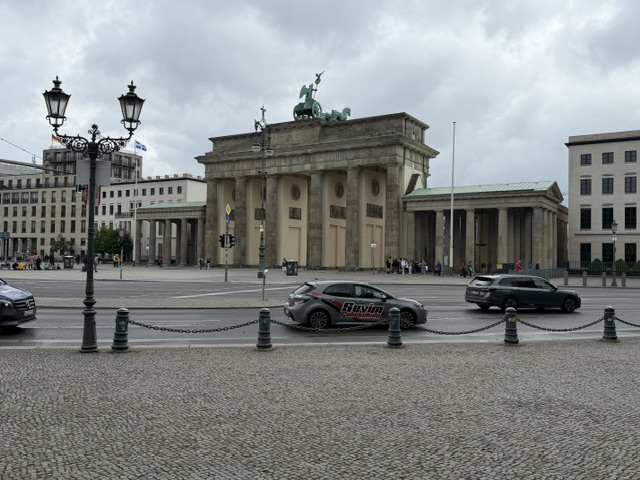
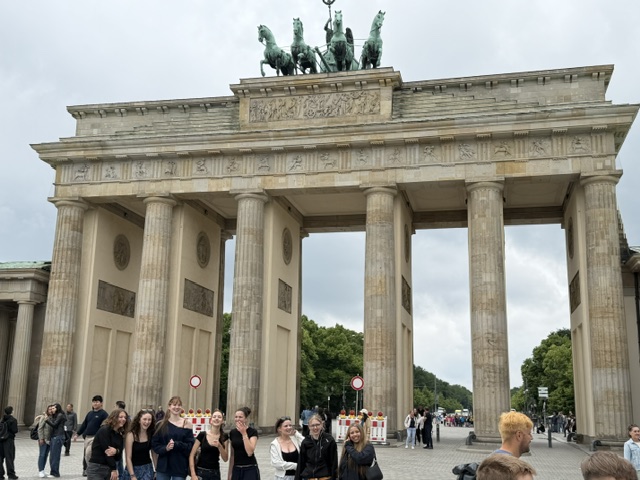
The Brandenburg Gate.
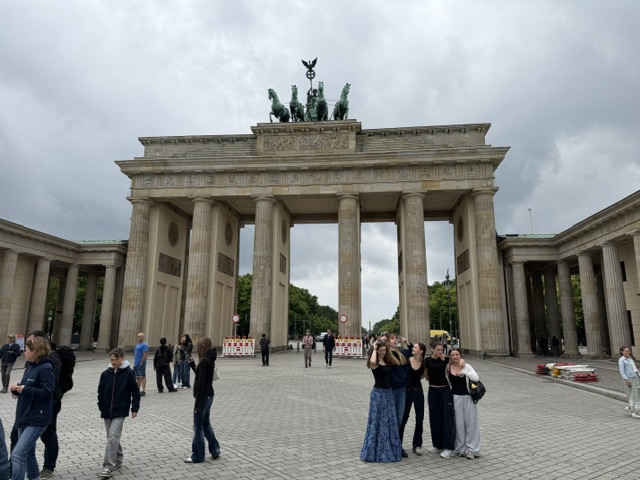
The other side of the gate. The girls on the right were jumping frequently so their photographer could catch them mid-air. Because that’s the mood the Brandenburg Gate symbolizes.
More gate. More girls.
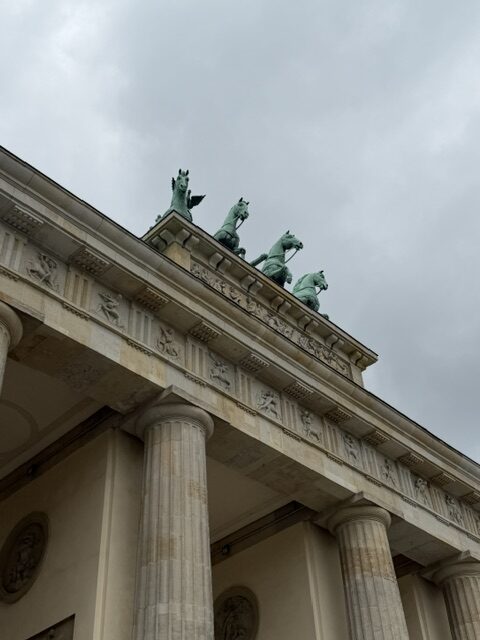
Me trying to be artsy with the gate.
A couple of blocks down the road is another memorial, this time to the Murdered Jews of Europe, also known as the Holocaust Memorial. It’s a field of over 2,700 concrete slabs of various heights that evoke a cemetery of tombs. It’s a stunningly simple and yet powerful remembrance of the estimated six million people who died during the Holocaust, and I wish someone would explain that to the hordes of tourists visiting who let their children jump around on them.
God, I’m sounding very “get off my lawn” today, aren’t I?
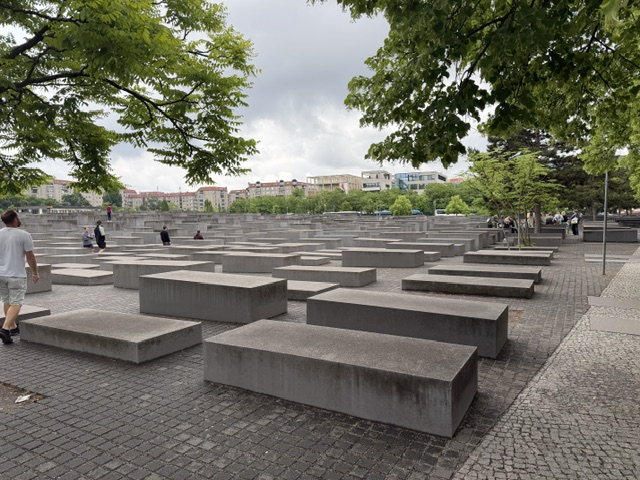
The Holocaust Memorial.
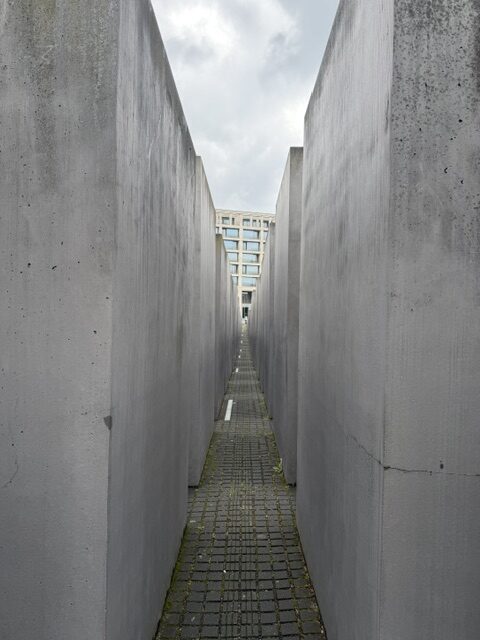
Amongst the slabs.
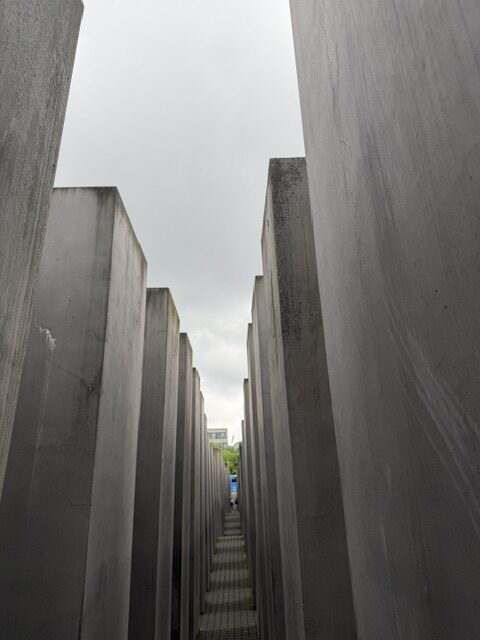
Another artsy view.

More of the Holocaust Memorial.

Evocative.
Under the field is an interpretive center that traces the history of the Holocaust. The inclusion of very personal stories of people and families makes it difficult to navigate emotionally. I came close to sobbing when I visited the room with panels in the floor showing letters and postcards from people who were killed in the concentration camps. One from a child read “Dear father, I am saying goodbye to you before I die.”
On my way out, one of the staff asked me how my visit was and all I could say was “overwhelming.” She nodded. She probably hears that a lot.
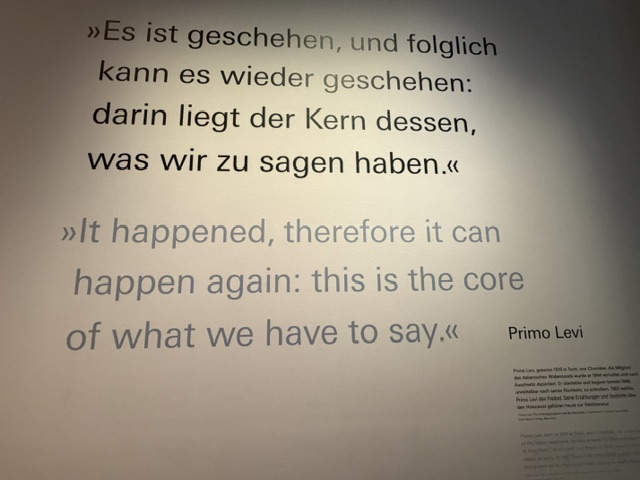
Yes.

Inside the Holocaust Memorial center.

Letters from the dead.

If this doesn’t break your heart, nothing will.
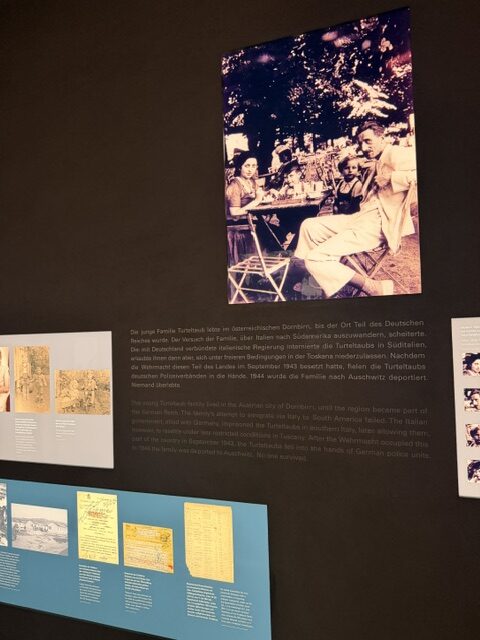
Entire families gone.

Anne Frank.
A few blocks away is a relatively innocuous parking lot, under which at one point was the bomb shelter known as the Fuhrerbunker. It was where Hitler married Eva Braun and then committed suicide as the allies approached. Some of it is still under the lot, but it is sealed off and only marked by a sign. Can you imagine parking your car there every day?

Parking on the bunker.
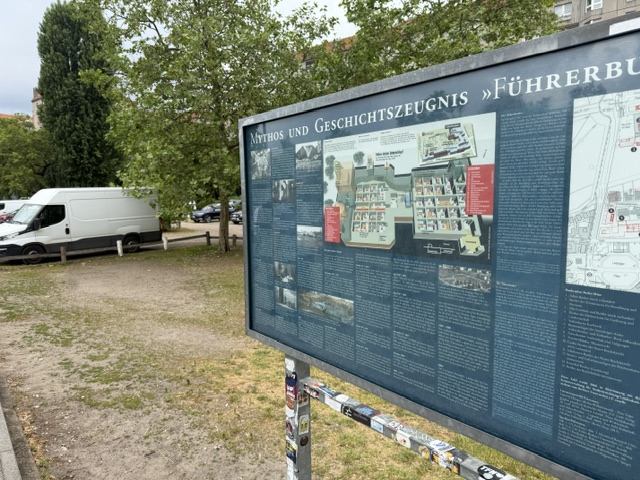
Diagram of the bunker.
Hunger set in after that, so I went to a nearby Italian joint called Ristorante Marea. A plate of spaghetti Bolognese was devoured quickly, partly because it was good but mostly because it was the comfort food respite I needed.
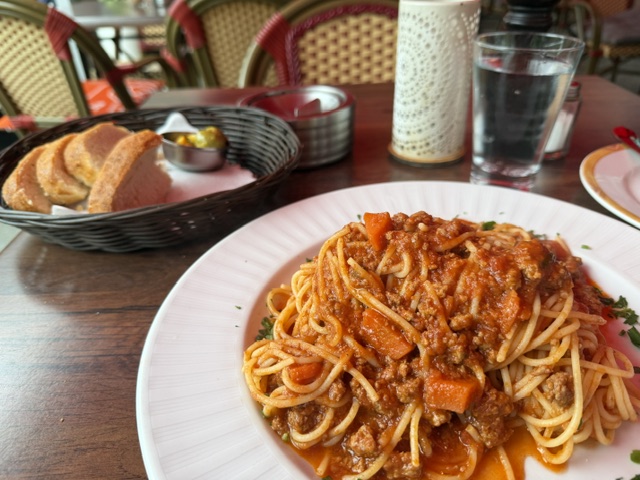
Italian food in Germany.
Next door to the restaurant is the German Spy Museum, an expansive facility dedicated to the craft of espionage. I’ve been to a few places like this, the fantastic Spy Museum in Washington DC and the Spy Museum & Immersive Experience in New York, which are leagues better than this one. Most of it is spycraft objects behind glass, but even the interactive elements – figuring out how to decode a message, trying to crack a safe, etc. – are fairly basic. They had a polygraph experience but it required two people to be the interrogator and interrogated. There’s also a laser maze and lots of selfie stations.
The biggest issue with the interactive bits was the hordes of people lined up to use them. This place is VERY popular, especially for families with kids, and I couldn’t get anywhere near most of the things that seemed even remotely interesting.
Get off my lawn.

I’ll be at the train station at midnight…
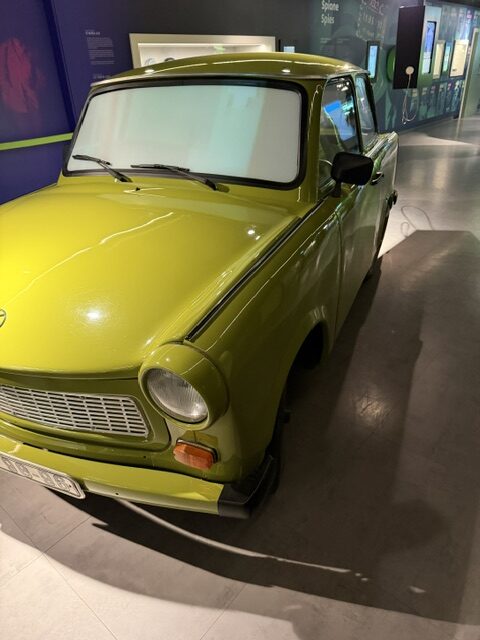
…wearing a yellow carnation…

…come alone.
Next door is the Deutschland Museum, another immersive and interactive facility tracing the country’s history from prehistoric times to present, with stops along the way in the medieval, enlightenment, industrial, Nazi, and midcentury modern eras. It’s very well done, but again mostly involving lots and lots of reading of fairly dry explanations of things.

The Deutschland Museum.
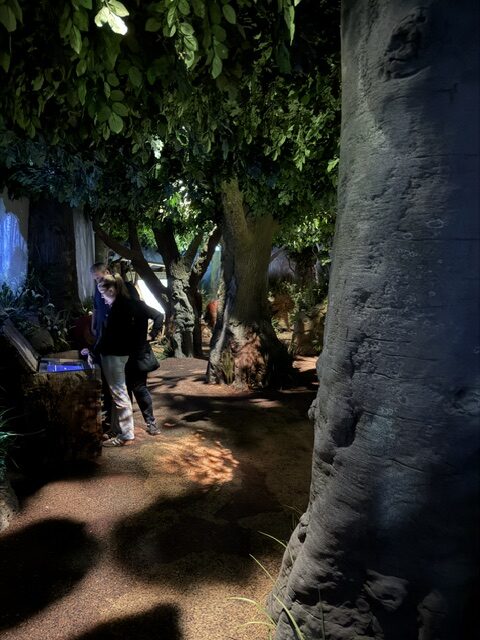
When they say history, they mean all of it.

Video projections as seen through windows.

The printing press. Good old Gutenberg.
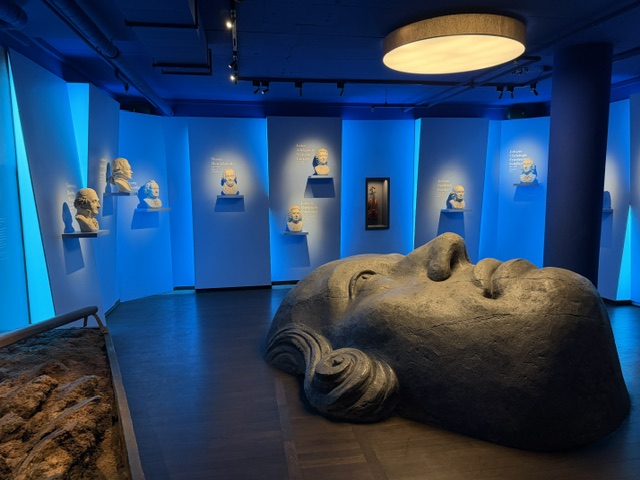
My, what a big face you have.
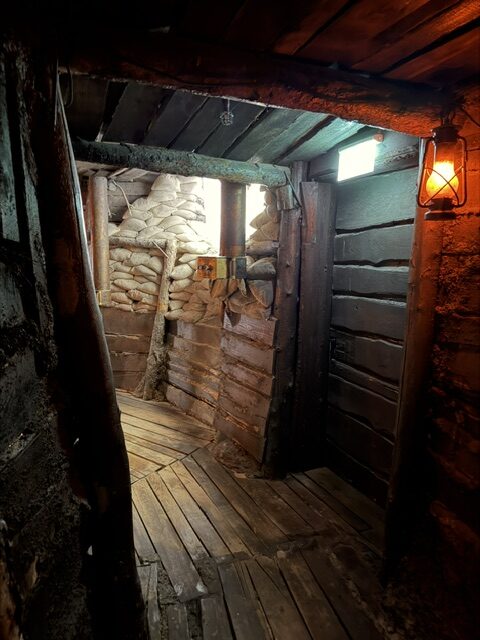
A section on World War II.

They didn’t gloss over the bad parts, which is good.
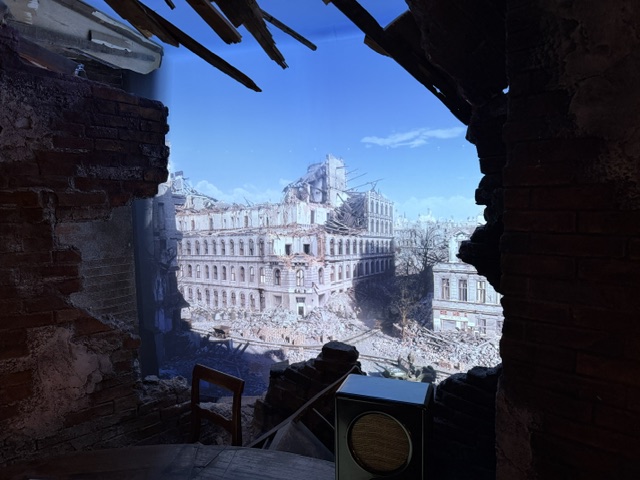
More video projection to tell the story.

Move in ready.

The subway cars lead to the exit.
On my way to my next destination, I walked past a building that had a random giant rooster sticking out of the side of it, dividing two halves of a balcony. We’ll call it Roadside Germanica.
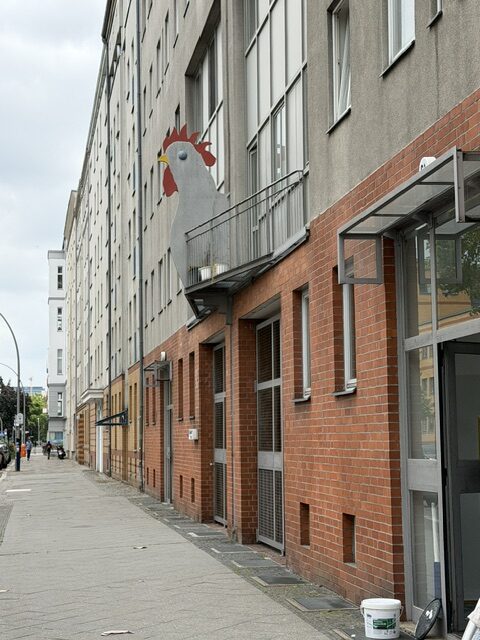
Cock-a-doodle, why?
My last stop in this tourism blitzkrieg was the Schwules Museum, dedicated to preserving the history of gay people in Germany. I’m sure it’s very cool, but when I visited more than half of it was closed as they were doing a new installation and the parts that were open had information panels that were almost entirely in German, so my comprehension was low.
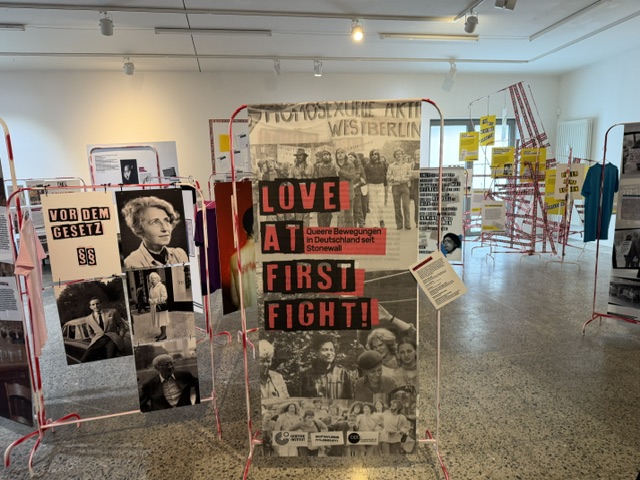
One of the few things in this room at the Schwules Museum that I was able to read.
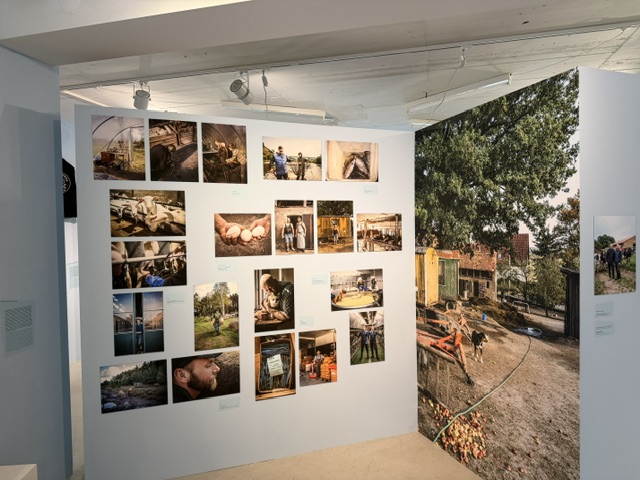
An exhibit on gays in rural areas.
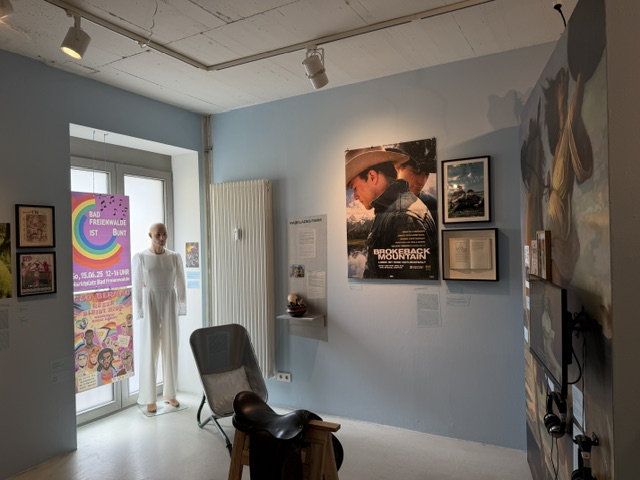
Unsure about most of this. I mean, I get the movie, but why the poster is here? Shrug.
I went back to the hotel for a much-needed rest – by that point I had already walked more than five miles – then eventually headed out for dinner at Elefant, another place specializing in German cuisine.
I started with the onion soup – smoky and rich with a hint that the onions were beer braised. I considered the schnitzel – they have about 15 different varieties including one with eggs and bacon – but was talked into the pork tenderloin served with more braised onions and mashed potatoes. The flavor of everything was fantastic but the pork itself didn’t live up to the tender part of it’s name. Still, a success.
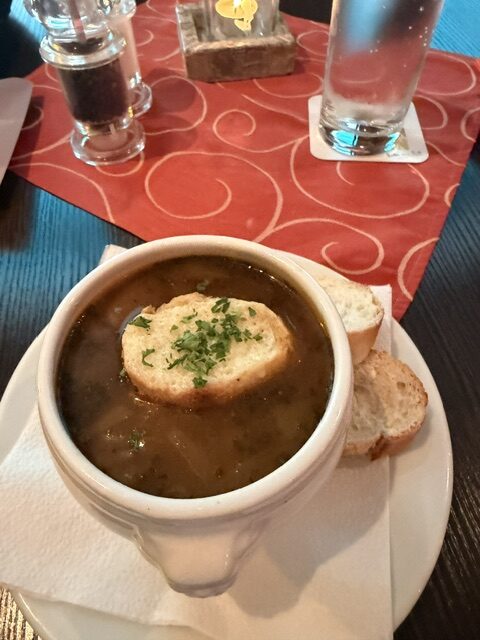
We both like soup.
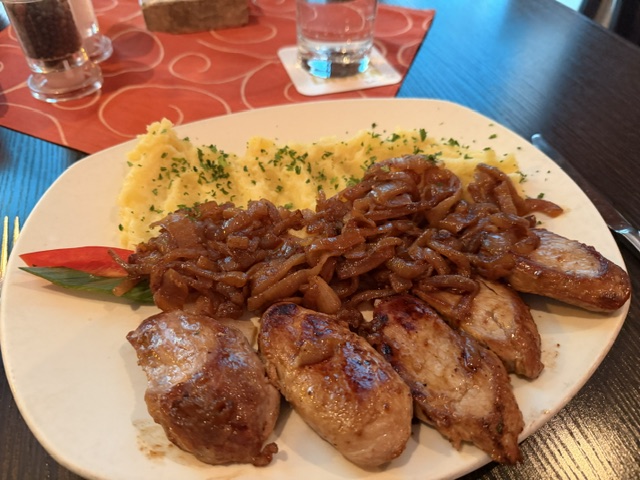
Pork toughloin. It was still good, though.
Tonight, I plan on checking out a few of the local bars but I won’t be writing about that or taking pictures.
Was in Berlin pessiert, bleibt in Berlin.