
Plucky Survivors See Europe: The Roads Less Traveled
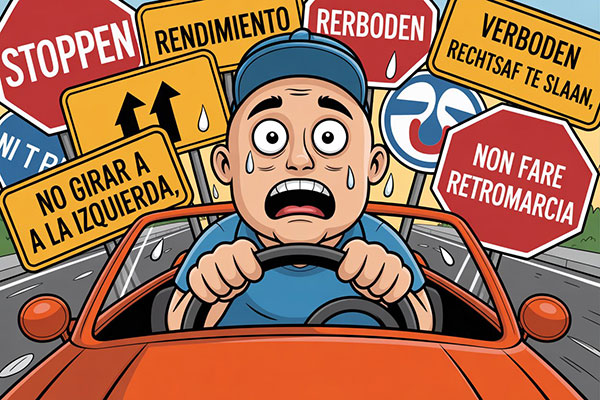
Most people do things the easy way – they fly to Europe and rely on public transportation or their feet to get them where they are going. Historically, I do things the hard way most of the time, although not always intentionally.
My road trip through Europe will take about 10 weeks and cover nearly 8,000 miles across thirteen countries and since it has the words “road trip” right there up front, it will naturally involve driving. This means having a car, of course, and as much as I’d like to ship the Jag to Europe (it’s really fun to drive!), a rental seemed like the more prudent solution.
Car rental in Europe is pretty much the same as it is in the US in terms of requirements and the process but finding what I wanted for a price that didn’t make me want to weep required a lot of trial, error, and patience.
The biggest roadblock (no pun intended) was the issue of mileage, or more to the point, kilometrage, which is real word apparently. Most companies have caps on how many kilometers you can put on their cars during the rental period and charge a fee if you go over, averaging about 50 cents for every kilometer. My trip is almost 8,000 miles, over 12,000 kilometers, and that would add thousands of dollars to the rental fee.
In addition, most companies charge drop-off fees if you plan on returning the car to a different location. My trip is going to start in Berlin and end in Amsterdam, so I was getting hit with that as well.
Then there was the issue of where I could go. Every rental company I looked at restricts the countries where you can drive their car, with most blocking any travel in most of Eastern Europe (Hungary, Greece, Croatia, etc.) and in the United Kingdom.
I finally found Europcar, a major car rental agency in Europe (hence the name), which has unlimited kilometrage and no drop off fees. They do restrict countries but the only one that affected me was my trip to London, so I’m going to park the car in Paris and fly back and forth.
I am not a small man and am old so fitting into and getting in and out of small cars is a non-starter. Plus, I wanted something nice since I was going to be spending so much time in it. I finally settled on a “premium mid-size” SUV, which will be something like an Audi Q5, a BMWX5, a Volvo XC60, or a Jaguar F-Pace like the one I drive (although certainly without the massive gas-guzzling V8 like mine has).
I’m adding full zero-liability coverage for collision, theft, exterior damage, and personal belongings ($20 per day); extended roadside assistance ($6 per day); interior damage coverage ($4 per day); and a “cross border” fee of $38 all-in. The total… well, let’s just say it’s a couple of grand more than the first-class airfare I bought. It is the single greatest expense of the trip.
And that’s not even counting gas, which is currently averaging about $9 per gallon across Europe. When I first started planning the trip, the average was around $7 per gallon, but you know, war. I’m currently budgeting about $3,000 for fuel alone.
So, cool… I’ve got a car and now I can just hit the open road and not worry about anything else, right? Yeah, no.
An international driver’s license is still required in many European countries including Italy, Germany, Spain, and the Czech Republic. Getting one is easy enough – you have to go to an AAA office, fill out a form, pay $20, and get your picture taken. Oddly, Savannah doesn’t have an AAA office, so I had to drive about 40 minutes to the far reaches of Bluffton to get it done. And apparently, I broke the camera just by having it pointed in my direction. It had worked all morning and then just stopped working for no reason when I got there. It took almost an hour to sort it out. Made me feel real good about myself.
Another big challenge was figuring out what other restrictions there are on driving in Europe and how to deal with them.
Many countries and/or cities I am visiting require “vignettes,” toll stickers that allow you to drive on major roads, and/or emissions certificates that validate you aren’t driving something that will destroy the planet. The problem is that in order to get any of these, you have to know the details of the car – the license plate, the make/model, etc. I won’t know that until I pick it up, so I can’t arrange any of that in advance. I modified my reservation to get the car a day earlier than I need it just so I’ll have time to fill out online forms for Czechian vignettes, Austrian vignettes, a Brussels environmental sticker, and a French “Crit’ Air” permit.
The latter has been especially frustrating. The Crit’ Air is a sticker that must be displayed on any car driven in most metropolitan areas of France. After an absolutely insane amount of research, emails, and phone calls I have discovered that you can only apply online and have the sticker mailed to you, which takes 2-3 weeks at best. I will need it sooner than that and won’t be stationary long enough to guarantee that I could have it sent to me. Based on what I’ve read on non-official blogs and websites, if I apply and print out the receipt, I can tape that to the windshield and that should cover me. At least that is what I think. I’m still not 100% sure and can’t get a straight answer from anyone official, which surprises me. I can’t be the first person who has rented a car in another country and needed to know about this, but the availability of authorized information is pretty much non-existent. I guess I’ll find out if it’s true when I get there, I just hope the knowledge isn’t delivered by a pissed off French traffic cop.
Related to this is a widely implemented practice of what is called a Limited Traffic Zone, or LTZ. These are in place in many cities across Europe, especially in Italy, and restrict what vehicles can drive on certain roads, usually in the more crowded historic cores. These can be all day or only part of the day, have a myriad of variations, and can often be implemented at the drop of a hat if conditions warrant. A road that you drove at 8am could be off limits at 3pm or you could turn a corner and suddenly be in a different zone with different restrictions. It’s mind-boggling.
There are no options for travelers to get permits for rental cars in those places (at least none I could find), so I have to avoid them or depend on the hotels or parking garages I’ll be using to register the car for me. I’ve read that Waze is pretty good at getting you around LTZs and only a couple of the hotels I’m staying at are within one, so I hope to avoid the hefty fines that are levied if you wander too far afield (upwards of $100 per infraction).
If I had to put a number to it, I’d say I’ve spent about 200 hours over the last few months setting a route, picking and booking hotels, determining what I want to see and do, figuring out how to get there, and dealing with all the car details to finally get to the point now where I have a mostly locked itinerary. Want to know the details? That’ll be in the next post.
Next: From Here to There