
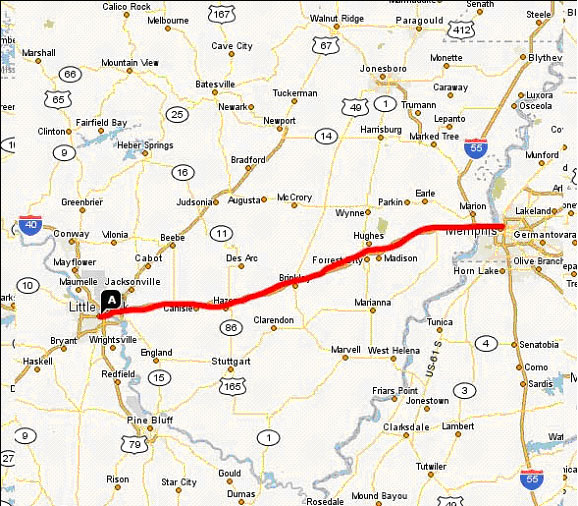
Plucky Survivors See America 2006 Day 5: Little Rock to Memphis
Date: September 5, 2006
Start: Little Rock, Arkansas
End: Memphis, Tennessee
Miles Traveled: 138
Highlights:
- Central High School; Little Rock, Arkansas
- Graceland; Memphis, Tennessee
- Stax Records Museum; Memphis, Tennessee
There is one disadvantage to a road trip, particularly one where the road (specifically, on average about 240 miles of it daily) is emphasized; it means you get wherever you are stopping for the night, and say things like “Wow. This looks like a really cool city. Hope we see it sometime.”
We knew that our focus was going to be more on the journey than the destination when we planned this trip but we weren’t expecting to be so charmed by the end points of many of these jaunts. Because we have been arriving kind of on the late side and are a bit tired (driving in circles, breaking into closed roadside attractions, and counting cows will take it out of you, take our word for it), we haven’t had the motivation to go out and explore the burgs we have winded up in. It doesn’t help that both last night and tonight we have beds made of rose petals and marshmallows and Rick has developed a cold, which makes him want to whine instead of wander.
Such was the case with Little Rock, a city we were charmed by even though much of it was closed in observance of Labor Day. So we had to content ourselves with a couple of walks along the river and a vow to return.
We did take the time this morning to stop at Central High School, scene of the 1957 integration conflict. A security guard, once he realized we weren’t up to do no good with our camera and car running, sweetly and proudly directed us across the street to a nifty preserved former classic gas station, now the site of an excellent exhibit on this piece of American history. No one can ever say enough about the grit and bravery those nine Little Rock students demonstrated. We were pleased to see that ground had broken on an even larger facility that will be dedicated to this epoch moment in the struggle for equal rights.
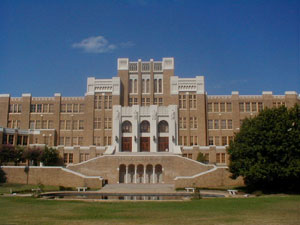
Little Rock Central High School.
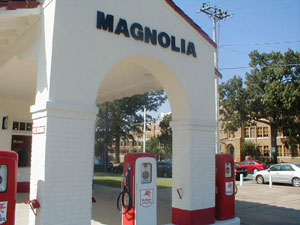
The museum is in an old gas station, but they are building a newer larger facility across the street.
Today’s drive was a relatively short one, which meant we felt we had the time to dawdle. This included getting off the freeway and on to another back road in search of a shack called Family Pies that Rick had found on some random Internet site in the blink-and-you’ll-miss it town of De Vall’s Bluff. Since it offered pies, fried pies and also more pies, we figured we couldn’t miss it.
But first, feeling leisurely, we stopped at a little diner for some juicy fried chicken strips, which was lunch #1, as you will see read.
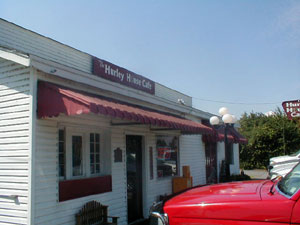
Near De Valls Bluff, good fried chicken!
Then it was back to driving around trying to find the not-precisely-signed pie shop and discovered that De Vall’s Bluff apparently has several other rival pie shacks. No matter; we tracked the right one down, set back from the road in a ramshackle structure that was…closed.
A guy raking leaves nearby said the proprietor, Miss Mary, was home in the house next door to the shop, so Plucky Survivor Mary knocked on her door. Miss Pie Mary, a southern-friendly woman in her seventies, answered and responded to our pleas (that went something like “Pie… drool… pie…”) by saying that she didn’t have any large pies, but she did have small ones, but only in chocolate and coconut. Since we stop listening at the point someone says “chocolate” we politely asked if she would sell us a couple. And she did. Oh boy, oh boy, oh boy.
Miss Mary’s family has been making pies for decades – she herself said she’s been doing it for “forty or fifty years” (she’s 75 and looks about 45) – and it shows. These perfectly personal sized pies were topped with thick meringue, supported by a cornmeal crust ever so lightly glazed with sugar, and filled with thick, fudgy custard. Mary ate half of hers before we got to the barbeque restaurant across the street, which wasn’t a wide street, by the way.
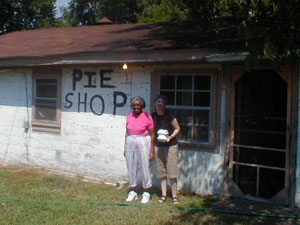
Mary, purveyor of pies, Mary, consumer of pies.
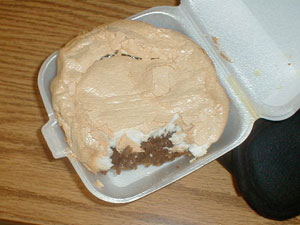
Mmmmmm, pie!
Craig’s BBQ is the shack of our dreams and so was the thick sliced pork sandwich we ordered. A soft bun, cole slaw, vinegar sauce (Mary ordered in mild to be on the safe side, which proved too cautious), tender meat, and all utterly divine. It’s going to be hard to beat that sandwich. Unless it’s fighting with against the pie and then the pie might win. Oooh, that could be a new show on Fox: roadside food death match.
Sorry, we get easily distracted when it comes to food.
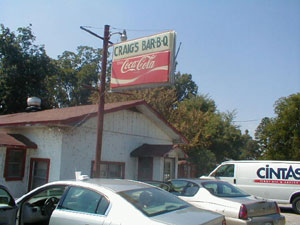
Right across from Mary’s Pie Shop in De Valls Bluff.
On the way out of De Vall’s Bluff we spotted yet another stretch of what we presume was a formerly thriving Main Street. We got a photo of this one, but know that all the others we’ve talked about here looked pretty much like this. Not all of them have divine barbeque and diviner pies yet virtually all of them suffered the same decay brought on by the freeway that replaced the highways that pass through little towns like this one.
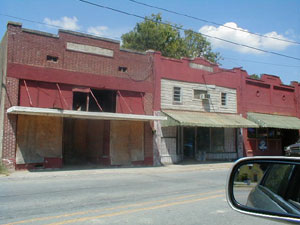
We saw a lot of towns that look like this.
While we enjoyed having the speed and access of a proper freeway for a day, Rick noted that this kind of driving is far worse for him than the repetitive stress of the twisting narrow roads of the previous days. Yes, it’s mostly just trees zipping by but there still always lurks the possibility of something very interesting around the corner, whereas from the big highways nothing much of interest can be seen. We have only to note today’s cow score: 0-0. And that’s not because we passed any cemeteries; we didn’t even see any of those.
Yesterday that big new interchange that liberated us, finally, from Branson’s clutches was newly created by blasting out a middle section of mountain, a raw scar on the gorgeous landscape. Another section is being developed, and will eventually supersede the small road we took most of the way. When it does, what will happen to Goat Gap and the other little towns (some of them Pop. 40) we passed through like De Vall’s Bluff? What will happen when they whither and dry up even further and the lovely Miss Mary passes on and her children, as they perhaps should or need to, seek out more verdant pastures.
That’s what it boils down to. When towns like this finally die, who will make the pies? That’s not a selfish question, but a cultural one, and one of grave importance that goes beyond pastry.
We don’t pretend to be saying anything new here, but its one thing to hear about it, and another to see it in action.
Our first stop in Memphis was the National Civil Rights Museum, which to our dismay is closed on Tuesdays. We decided not to break into this one (though only after some mental struggle—it does mean rejiggering our plans for tomorrow), and instead turned around to face the behemoth roadside attraction that is Graceland.
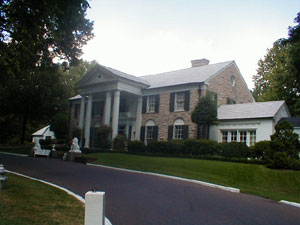
Elvis hasn’t left the building.
Now, don’t get us wrong; we understand and appreciate the Elvis myth. Mary even has a metaphor for America based on Elvis. Ask her sometime. But we felt less enthusiastic about going to Graceland than obligated.
We weren’t any more excited when we saw that it has turned into a serious amusement park racket, with a giant visitor’s center, separate admission for different sections of Elvis-folly, and $54 t-shirts.
Visitors now have to take a shuttle just to go across the street to the mansion and tours are entirely electronic, featuring way-too-somber-and-serious narrative. We didn’t expect Albert Goldman-style gossip and snark, but when Elvis and the Memphis Mafia are depicted as a fun-loving group of guys involved in wholesome hijinks, and there is a nary a mention of TV shooting (or guns at all) and pills don’t enter the picture until the last moment when an addiction is mentioned in connection with his death, you know the thing has been sanitized and hagiography rules the day.
Plus, how can anyone describe those interiors, the archetypal example of how 1970’s design lost its mind, in any positive way? We appreciate shag carpeting as much as the next guy but perfectly preserving this time capsule space and expecting anything other than giggles and pointing is just plain silly.
We were also surprised to see how small the house really is. It’s strange in these days of MTV cribs to see such a mega-star living on a relatively modest scale, although maybe in retrospect that’s kind of refreshing. Really, just because you can build a 50,000-square-foot shrine to indulgence doesn’t mean you really need one.
Shots of the grave site don’t show the perspective accurately; it’s just a few steps away from the pool, and we wonder how Vernon or anyone else who kept living in the house after Elvis’ death could ever enjoy the backyard again.
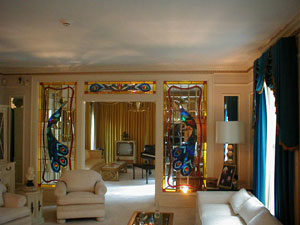
Graceland, Living Room.

Graceland, Dining Room.
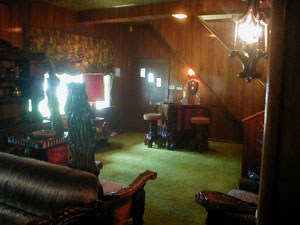
Graceland, Jungle Room.

Graceland, TV Room.
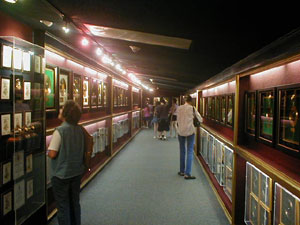
Graceland, Hall of Records.

Graceland, Pool (Lisa Marie: come on kids, let’s go swimming near Grandpa’s grave!).
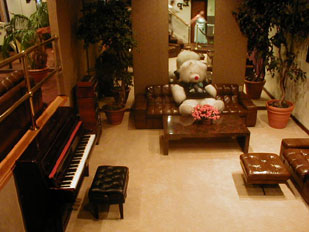
Graceland, Recreation Room – he purportedly played that piano the morning of his death.
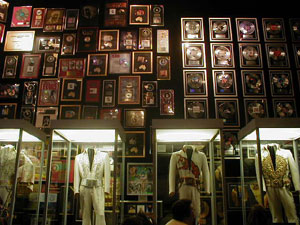
Graceland, Former Racquetball Court.
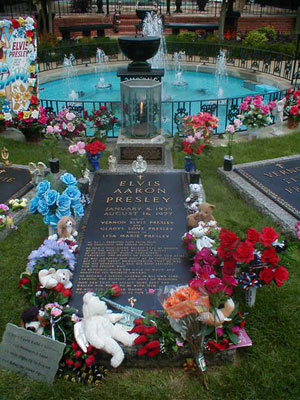
Graceland, Grave.
Somehow, all of this ties into our Britney Spears meditations from day 1: do any of the hungry, ambitious, driven kids from small towns see this as a cautionary tale and realize they have to make an effort so that their path diverges, that they do not end up gone long before their time with shuttle buses ferrying people to their former home so they can snap pictures of the ugly furniture?
We got the hell out of there as soon as we could and went to the far more satisfying Stax Records Museum of Soul. Stax was the home for artists such as Otis Redding, Wilson Pickett, Sam & Dave, and many impressive more, located in the middle of Soulsville, USA, a neighborhood distinguished by such residents as Memphis Slim and Aretha Franklin.
The building was demolished a few years ago but the museum faithfully recreated it complete with a replica of the original recording studio plus an actual tiny gospel church rebuilt in a large room at the start of the exhibit. Terrific graphics explain the development of soul music, from its gospel roots, throughout the US. This is a terrific facility, far more significant and educational than the florid and indulgent bigger name down the street, and we encourage visitors to Memphis to see it.
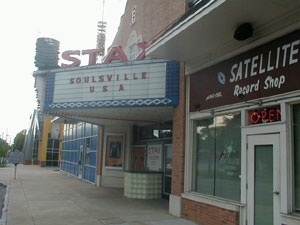
Stax Records.
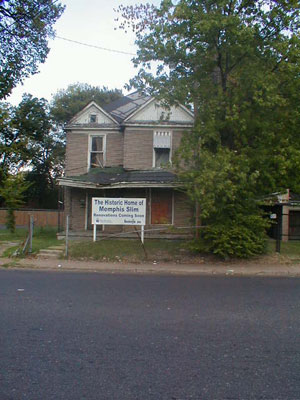
Behind Stax Records.
Tonight we are at original Peabody built in 1925 as a replacement for the original Memphis Peabody, which opened in 1869. This is an elegant and gracious throwback and the place where the ducks first began to waddle in their daily parade. We missed their 5pm promenade but Mary went up to the roof to visit them in their penthouse. Yes, the ducks live better than you do. Accept it and move on.
Our rooms are every bit as comfortable as the ones last night (beds made out of angel wings, we tell you) though Rick’s is bigger and sunnier, with a view of the Mississippi, than Mary’s. So he deserves it. He’s doing all the real work on this blog, and he has a cold. Anyway, the same level of service—bless them, every porter was happy to indulge us in our quest to figure out the best place to have barebeque tonight—holds here, and it’s about as beautiful a hotel as we’ve experienced. It’s location in Memphis couldn’t be more perfect – a block away from Beale, a quick freeway ride to Graceland, and right smack dab in the middle of a bustling downtown district.
Our two nights in Peabody hotels have turned us into unflagging fans of the brand. So much so that we were debating which hotel we preferred and then we realized, heck… they are in different cities so you don’t have to choose between them. Little Rock and Memphis are great small cities and if you ever find yourself visiting one or both we have a hard time seeing how you could do any better than the Peabody.
The barbeque debate was resolved by our decision to stick close to the hotel and so we ended up at the recommended Blues City Café where the well-dry-rubbed rib meat fell off the bones, absolutely perfect. The guy at the door gave us a suggestion for a fried chicken place for tomorrow and told us precisely what to order at a couple of other, more out of the way barbeque spots said he thinks Blues City is the best. And this is after we ate there so it’s not like he was trying to sell us.
A stroll around downtown Memphis shows another graceful southern city making moves toward greatness. Of course there’s Beale Street, tourism central (Hooters, Hard Rock, etc.) but still funky with some juke joints and real live blues bands playing for free in open air parks. But we were also impressed by the Main Street revival, still underway but heading in a good direction. They have closed the street to traffic and installed a trolley line and dozens of buildings are being converted into condominiums, a move that concerns us from a gentrification perspective but at the same time we realize that without them the area would be “nothing” as one local told us.
We’re back to the whole “What a cool town, I wish we had seen it” thing again.
Tomorrow we head back into Mississippi for a visit to Clarksdale and on to Tupelo for some more modest Elvis sightseeing.
Thanks for reading everyone!
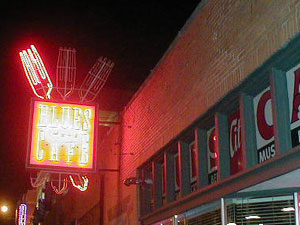
Blues City Barbeque.
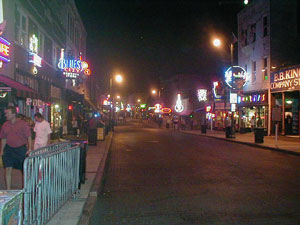
A fairly deserted Beale St.
Full Moon Over Memphis.
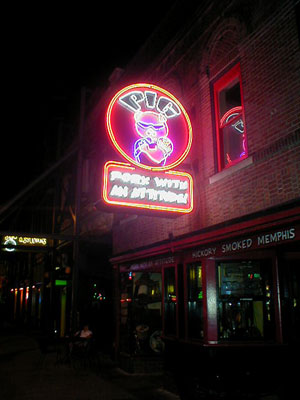
More Scavenger Hunt Points.